A Stratpharma product
Home / Clinical evidenceThe science behind scar care

Clinical evidence

Silicone therapy has a primary role in scar management. Explore clinical research involving Strataderm, international recommendations and documented clinical cases.

Silicone scar therapy

From established therapy to everyday care

A brief history of silicone scar therapy
01 / Silicone scar therapy

A brief history of silicone scar therapy

Silicone gel sheeting has been used successfully in scar management for decades: it improves the signs and symptoms of existing scars, and prevents the development of abnormal scars.

However, silicone gel sheets have several limitations in their use. It is not practical to use sheets on large areas, near joints, on the face or other areas where they cannot adhere well. The sheets are very visible and their handling is rather complicated. Frequent washing is necessary to prevent rashes and infections. Silicone gel sheets can be expensive because several sheets may be needed to fit one scar.

Reference: Mustoe TA. Evolution of silicone therapy and mechanism of action in scar management. Aesthetic Plastic Surgery. 2008;32:82–92 (published online 2007). Read the review ↗

The new generation of scar treatment
02 / Silicone scar therapy

The new generation of scar treatment

In recent years, a new generation of silicone gels for the prevention and treatment of scars have emerged. They are just as effective as traditional silicone gel sheets but they are much easier to use.

The innovative concept is their liquid and self-drying formulation. They can be applied in a very thin layer and form a self-drying, flexible, transparent and gas-permeable silicone gel sheet which is in constant contact with the skin (24/7).

In several studies, patients and doctors were highly satisfied with silicone gel treatments. They praised the ease of use, treatment duration, cosmetic outcome and tolerability. Strataderm belongs to the family of the new generation of scar treatment and prevention silicone gels. It was developed with new technologies, to have a quick drying time and a superior durability. Strataderm adheres strongly to the skin which is why it only needs to be applied once daily.

Apply once daily, twice daily to exposed areas, or as advised by your physician.

Background: Mustoe TA, 2008.

International scar recommendations
03 / Silicone scar therapy

International scar recommendations

The literature is extensive on the prevention and management of scarring using silicone. There are literally thousands of published articles of varying quality on scar management and even more products available worldwide including over the counter, over the internet, prescription based only and health professional delivered only based products that claim to help prevent and treat scarring. However, the evidence, until recent years, was not strong on the best treatments for scarring.

In 2014, an International Advisory Panel on Scar Management published clinical recommendations on scar management, based on a qualitative overview of 300 published references and expert consensus on best practices. Silicone Gel Sheeting (SGS) was recommended as first line therapy for prevention of scarring and first line treatment for the initial management of scarring, in addition to the recommended management modality with adjunct therapies for secondary management. These clinical recommendations to date have not been superseded.

Source: International scar recommendations — original Strataderm website ↗

Published research

Silicone gel – Clinical efficacy in scar therapy

An observational study about the use of a liquid silicone gel (applied from a tube) to treat scars was conducted by 66 private practice dermatologists over a period of 20 months. The study included 1522 patients with hypertrophic scars, keloids, and other types of scars.

Observational study66 dermatologists20 months of observation
1522
patients were included in this study
3
months was the average treatment period
83%
of the doctors rated the treatment as “good” or “very good”
99%
of dermatologists rated the tolerability of the silicone gel as “good” or “very good” throughout the whole treatment period
Results

Clinical results with Strataderm®

Clinical efficacy

Strataderm® – proven clinical efficacy

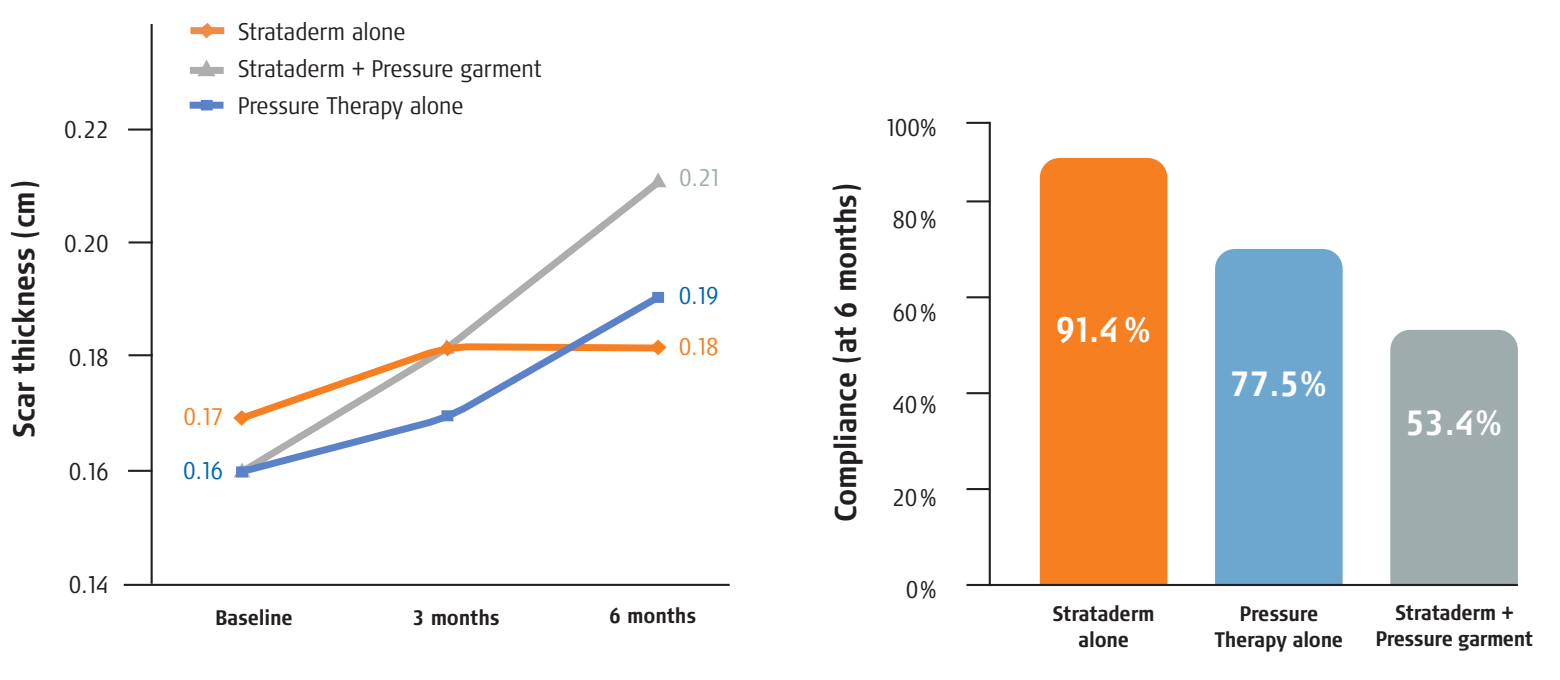
A 153-paediatric patient study conducted in Australia investigated the efficacy of Strataderm versus pressure garment and combined therapy for the treatment of post-burn injury scars.1

n=51 in the Strataderm group

n=49 in the pressure garment therapy group

n=53 in the combined intervention group

Original scar thickness and compliance charts
Scar thicknessCompliance at 6 months

Study results

01

Strataderm and pressure garments were confirmed, with statistical significance, to have the same clinical efficacy in the prevention and treatment of post-burn scar.1

02

Strataderm has less adverse effects, is easier to use and has better patient compliance compared to pressure garments.1

03

At 6 months, caregivers and observers using Strataderm alone, reported better patient compliance, improving overall scar appearance and health-related quality of life compared to pressure garment alone and combined group.1

04

Strataderm was reported easier to use compared to pressure garment therapy alone or combined therapy, where reduced intervention adherence and satisfaction were reported.1

05

Less adverse effects such as skin irritation or wound breakdown were observed in the Strataderm group compared to pressure garment group.1

1. Wiseman, J., et al. (2019). ‘Effectiveness of topical silicone gel and pressure garment therapy for burn scar prevention and management in children: a randomised controlled trial’, Clinical Rehabilitation, doi: 10.1177/0269215519877516.

Read the trial ↗ · Read the 12-month follow-up ↗

Documented cases

Results in individual scars

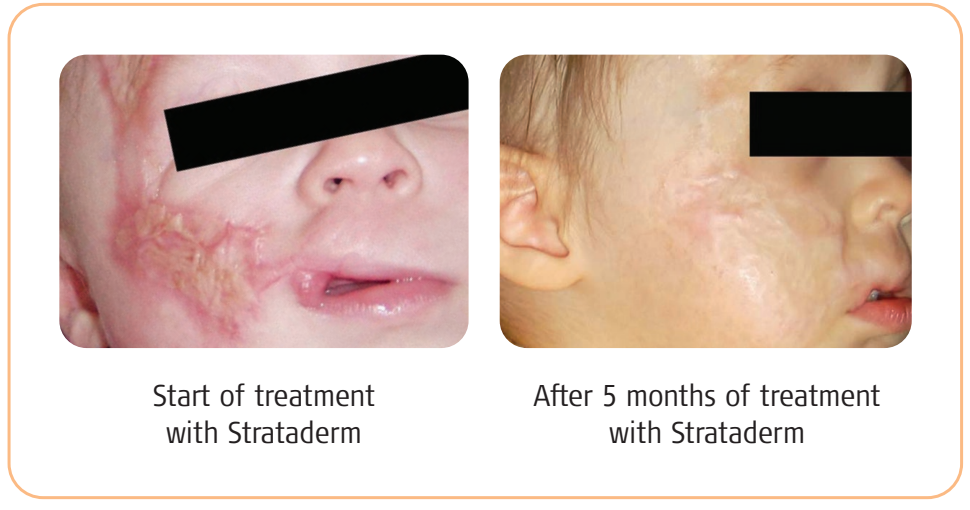
Widespread hypertrophic scar after deep thermal contact burn – face2

Age of scar before treatment: 2 months. Age of patient: 6 months old.

After 1 month of treatment with Strataderm, a reduction in pruritus, oedema and erythema was observed. The colour of the scar was lighter, its surface was smoother.

After 5 months of scar treatment (8 months post-trauma), the postburn erythema had completely resolved, and the scars were smaller and softer. An important reduction of the deformation of the right side of the top lip was also visible.

Original clinical photographs and treatment results
Start of treatment with StratadermAfter 5 months of treatment with Strataderm

2. Marini, L., Odendaal, D., Smirnyi, S. (2017). Dermatologic Surgery, 43, pp. 85–90.

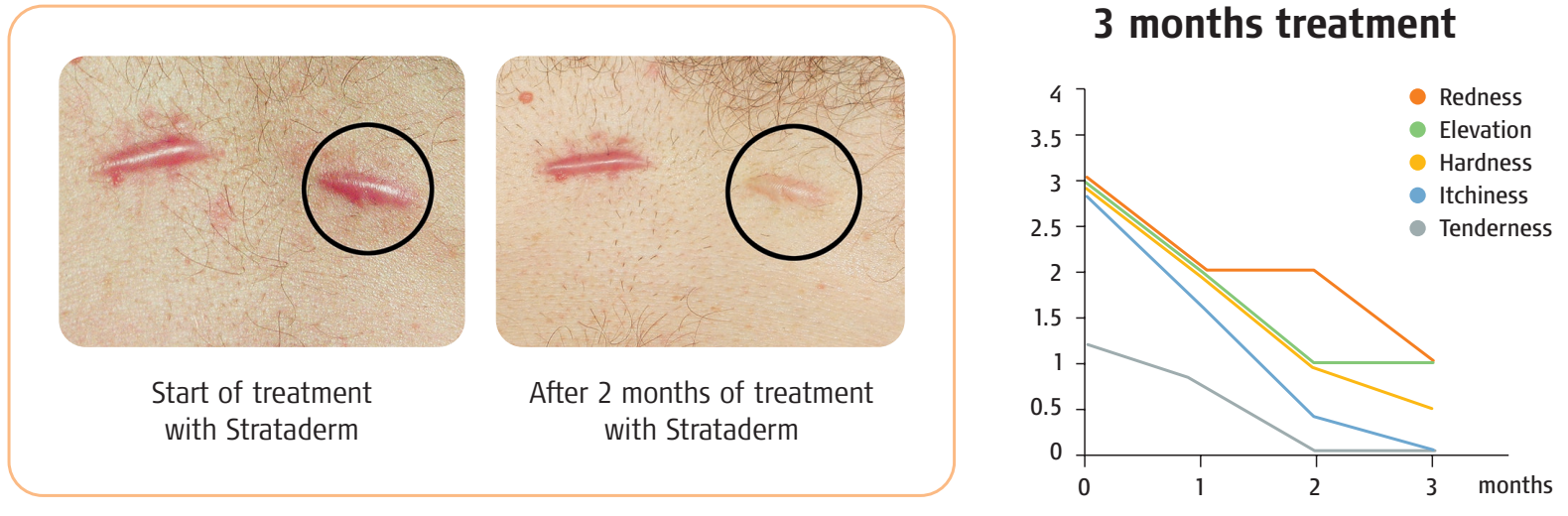
Linear hypertrophic scar after nevus extraction – chest3

Age of scars before treatment: 14 months.
Left scar remained untreated, right scar treated for 2 months.

Original clinical photographs and treatment results
Start of treatment with StratadermAfter 2 months of treatment with Strataderm3 months treatment

3. Data on file, 2010 (Dr. A. Irwin study). Stratpharma AG.

Linear hypertrophic scar – head3

Age of scar before treatment: 2 weeks.

Original clinical photographs and treatment results
Start of treatment with StratadermAfter 3 months of treatment with Strataderm3 months treatment

3. Data on file, 2010 (Dr. A. Irwin study). Stratpharma AG.

Research in focus

Whitepapers

01 / StratadermEnglish · PDF

Strataderm® cost-effectiveness of post-burn scar management

Scar management in children remains a challenge, and the costs associated with these interventions are important considerations for healthcare services. This study examines the cost-effectiveness of three scar management interventions: pressure garment monotherapy, topical silicone gel (Strataderm®), and a combination of both interventions, through a randomised controlled trial. The research involved 153 children who received scar management for 6 months following burn injuries at Queensland Children‘s Hospital in Brisbane, Australia. The cost-effectiveness analysis was conducted from the perspective of a health service provider deciding which intervention approach to implement in a scar management clinic.

McPhail et al. · Scientific Reports · 2022

02 / StratadermEnglish · PDF

Strataderm® effectiveness of post-burn scar management compared to pressure garments

This study, conducted in Australia, aimed to assess the effectiveness of silicone gel (Strataderm®) and pressure garments, alone or in combination, for scar management in children post-burn. In a multicentre, randomised controlled trial involving 153 participants aged 0–18 years, the groups were assigned to receive topical silicone gel only (Strataderm®), pressure garment therapy only, or a combination of both. The primary outcomes focused on scar thickness, itch intensity and treatment adherence at six months post-burn.

Wiseman et al. · Clinical Rehabilitation · 2020

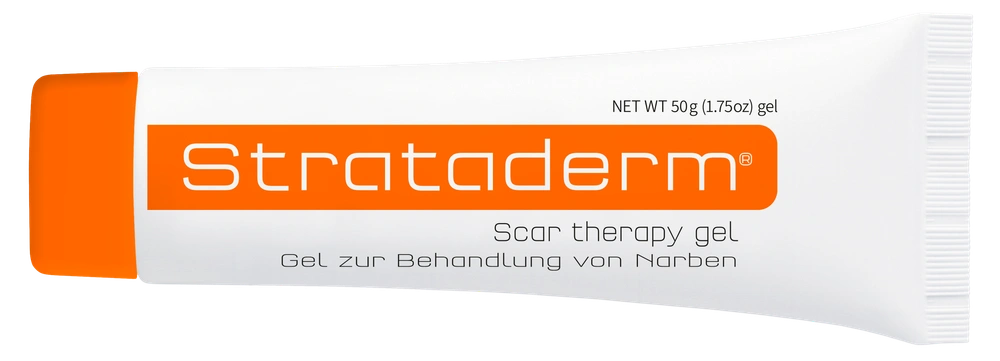
Strataderm 50 g tube
Strataderm

Buy online

Order Strataderm from the Stratpharma online shop.

Buy online

Country and language

Choose the website for your market.

Strataderm

Your location

This Strataderm website content is not intended to be used by United States residents.

If you are a US resident, please visit our US website to find the right product for you.

Cookie preferences

Essential storage is always on. You can change optional choices here at any time.

Search this website